



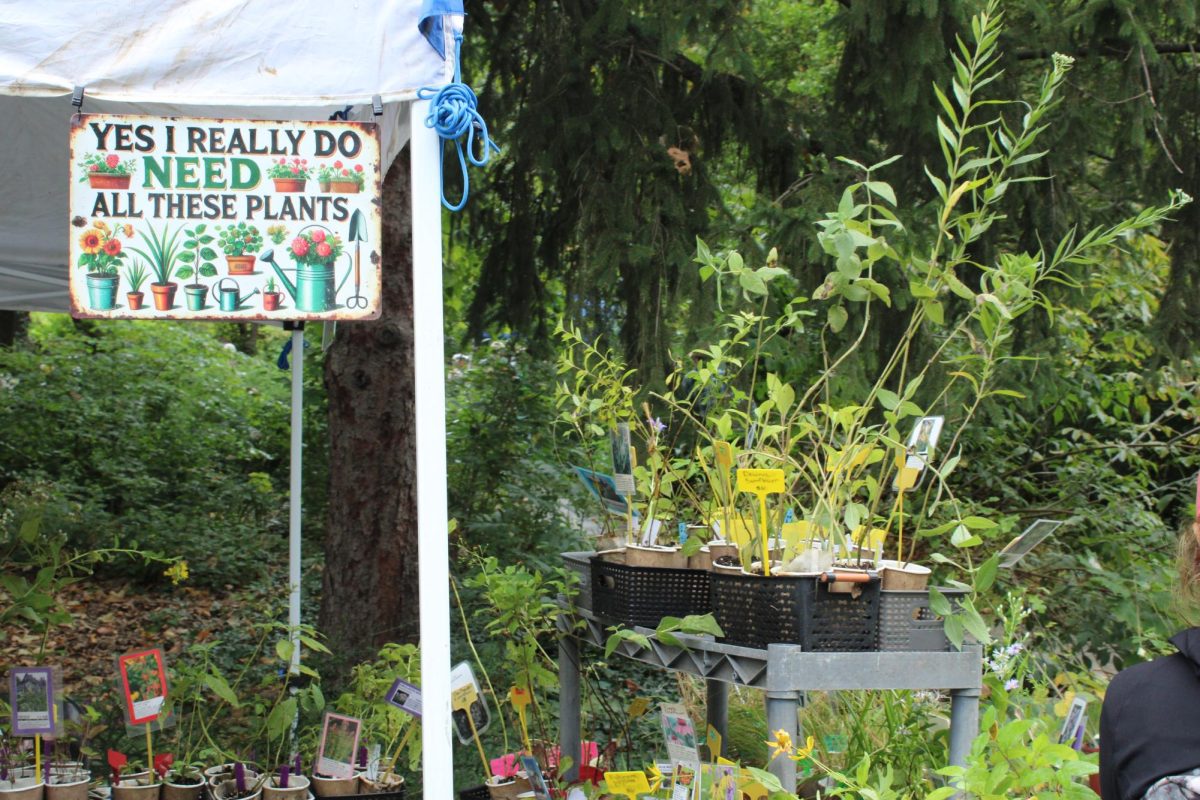
While the midwestern winter seems never-ending in Cincinnati, warmer temperatures are nearing. The thousands of plants which lay dormant beneath the frosted-over ground will soon sprout and bring the fresh start synonymous with springtime.
A large supporter of these plants is the Civic Garden Center (CGC), a nonprofit organization dedicated to educating and building a community around gardening and agriculture. They host an annual Native Plant Festival, bringing in native plant vendors and educational speakers from across the region to promote conservation efforts.
With a similar mission, Bio-Eco Club has served as a vendor at the Native Plant Festival for the past three years and works closely with the CGC for conservation projects. At the 2025 Native Plant Festival, the club sold 27 native trees and made around $540.
“We [sold] red maples [and] a bunch of different types of oaks; oaks are big in Ohio,” Ava Bley, ‘27, vice-president of Bio-Eco Club, said. “[We have] Bur Oaks and White Oaks and Swamp White Oaks, as well as Ohio Buckeyes, Yellow Buckeyes [and] Black Gum trees. Also… we grow Pawpaw trees, which are really big [here as well].”
The festival serves as both a fundraiser and an educational effort for Bio-Eco Club. Members get to educate other plant lovers on the process of growing native trees at WHHS and receive money to support conservation efforts.
“These plants will go out into the community,” Bley said. “[Others will] be able to talk about them, [and] they will be conversation starters. People will see them, and they’ll know more about our club [and] more about native plants. It will inspire people to start planting more native trees in our communities.”
Native plants are the driving force behind this festival, but many do not understand how they contribute to the ecosystem and affect our environment.
“To explain why native plants are important, I have to explain why invasive plants are so bad,” Bley said. “Invasive plants come from other countries, mostly other continents, such as Europe and Asia, and things like honeysuckle [and] porcelain vine… take over woods. They take up a lot of space, and are generally inedible for our bugs.”
Invasive plants result in a decrease of native wildlife, which leads to a disruption in pollination, climate regulation and food security.
“Native insects have evolved to eat native plants, so when you plant native plants, that means more insects, and in particular, more caterpillars,” Alexandra Mondini, science teacher and Bio-Eco club advisor, said.
Mondini has been an advisor for the club since 2017, around the time when the cleaning and re-planting of Walnut Woods was happening.
“Before I was the advisor of the Bio-Eco club, I was working on Walnut Woods,” Mondini said. “It seemed like that advisor was wanting to step down, and I was already organizing groups of students to work in the woods, and I was like, ‘Well, that just makes sense [if I am the advisor].’”
Before Bio-Eco club’s conservation project in Walnut Woods, the woods were inaccessible, filled with trash, TVs, old mattresses and other discarded items. They also contained honeysuckle, an invasive plant that had stripped the woods of their natural ecosystem.
“It was pretty impenetrable… But it was 10 acres of woods, and [I was] like, ‘That should be a park,’” Mondini said. “Green space in Evanston is kind of hard to come by, and this is 10 acres of woods right here. [I was like], ‘Why are we not using this?’”
As a result, Bio-Eco club members began pushing for a greener space. They contacted the CGC to have volunteers come and help clean out the woods, and they took the issue all the way to the City Council to petition that Walnut Woods be designated as a park.
“Once the Civic Garden Center became a part of it, it really took off, because they are an amazing organization for organizing community volunteers,” Mondini said. “It wasn’t just WHHS students anymore, it was people from the community. [Fast forward several years] we drafted a proposal that was approved by [Cincinnati] Parks, [making Walnut Woods] an official park.”
With the help of more people in the community, Bio-Eco Club was able to clean out the woods in just a few years. Finally, in 2021, they drafted a proposal that was approved by Cincinnati Parks, and, in 2022, Walnut Woods became an official park.
“That’s the story,” Mondini said. “It was just a small group of students that were like, ‘Hey, why is this a wasted space? Let’s do good in our own community,’ and then it snowballed into the park with trails [we now have].”
Another plant-lover present at the Native Plant Festival who is also very passionate about sustaining native ecosystems came from Delaware, Ohio, to sell native plants and spread awareness. Denise Gualtiere is a member of Scioto Gardens, a plant nursery north of Columbus that specializes in breeding native plants.
“We grow our own pots [and] grow our own plants,” Gualtiere said. “Everything’s grown outside all year round. We don’t throw anything in a greenhouse, so everything’s completely acclimated.”
In accordance with their pro-green stance, Scioto Gardens also uses natural materials when growing and potting their plants.
“We mix our own soil,” Gualtiere said. “It’s a mixture of native soil and compost and some other things to make it a little bit lighter weight. We also grow in root pouches, which are a pot made out of recycled butter, bottles and fabric. The roots will grow out into the side, and when they hit the side, they’re exposed to air. Instead of circling around like we do in the plastic pots, they’ll stop growing and they’ll branch out, so we get a really nice, dense root system.”
Despite the major effort organizations such as Scioto Gardens put into creating a natural and native ecosystem in Ohio, their efforts will have little effect unless others take similar steps.
“There’s a particular author [named] Doug Tallamy [who] looks at all the privately owned land in the U.S. and [he says] if everyone, just in their own little yard, planted native plants, we would completely save the bird population,” Mondini said.
Along with being beneficial for the environment, growing a garden helps average citizens feel in control of their environment by promoting civic duty.
“Right now… there’s a lot of feeling not in control; there’s government policies, but we don’t get to write the government policies,” Mondini said. “But something that you can do locally, [and] you don’t need anyone’s permission [for], is just to plant a native tree or native flowers. When you do that, you will see the wildlife come to you.”
Despite the benefits, starting a garden is often a struggle in the beginning. It can be difficult to know where and how to begin, but knowing the main factors involved, such as light and soil pH, can help people get on the right path.
“Study your site, get to know your site, [get to know your] sun and light conditions, get to know your soil and read,” Gualtiere said. “Do a lot of research on the things that you want to grow, and try to match the things that you want to grow to your site conditions.”
Protecting native ecosystems is essential to the preservation of native wildlife, and it serves as an impactful pastime. As people start cultivating their garden, they also cultivate a village of supporters to help them along the way.
“It’s a hobby with community, lots of volunteer opportunities and so many amazing people and connections,” Bley said.