


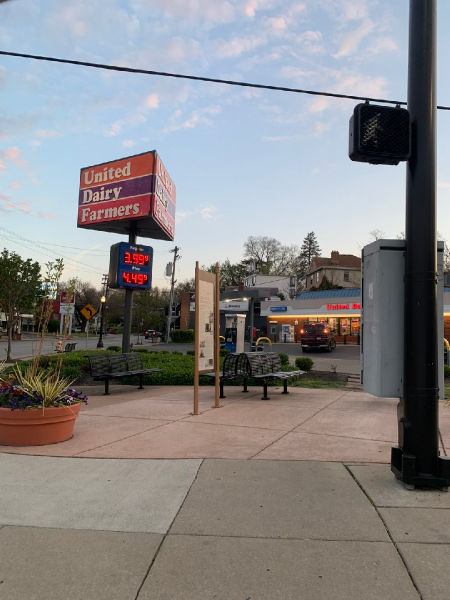
Gas prices have increased over a dollar per gallon since March 1, with the national average being over four dollars a gallon, the highest price since 2022. This comes as a direct result of the war being waged in Iran by the United States and Israel.
Gasoline prices are consistently an economic indicator. Higher prices at the pump squeeze household budgets, dampen consumer spending and place an additional financial strain on businesses.
Energy markets are one of the quickest things to react to geopolitical instability. The recent conflict in Iran has added volatility to the global oil market, with prices rising amid uncertainty over the ability to distribute oil through the critical Strait of Hormuz, a waterway which connects the Persian Gulf to the Gulf of Oman and, eventually, the Arabian Sea.
According to the U.S. Energy Information Center, about one-fifth of global oil and petroleum product flow through the Strait of Hormuz.
In addition, around one-fifth of global liquefied natural gas also passes through the Straight. Natural gas is key for the production of systems such as electricity and heating.
Iran sits on the northern end of the strait and has used its military capabilities to shut down the traffic of ships through the area. The Iranian Government claims it will “set fire” to any ships that attempt to sail through the strait. Ali Vaez, director of the Iran Project at the International Crisis Group, emphasizes the importance of a healthy energy market in the 21st century.
“In the attempt to try to prevent Iran from developing a weapon of mass destruction, the U.S. handed Iran a weapon of mass disruption,” Vaez told Reuters. “[Iran’s chokehold on the Strait of Hormuz] is much more potent than even a nuclear weapon.”
Here at home, the national average price of gasoline is $4.11 per gallon as of Apr. 5, up 86 cents from one month ago, according to AAA. With no end in sight without the reopening of the strait, President Donald Trump publicly warned Iran of further attacks in a fiery social media rant.
“Open the F***** Strait, you crazy b****, or you’ll be living in Hell – JUST WATCH!” Trump wrote in a Truth Social post directed at Iranian leaders.
Economists expect prices to decrease after the Strait of Hormuz is reopened and the conflict with Iran simmers down. However, the timeline of an end to the war is still up in the air. Trump announced at the start of his operation on Feb. 28 that the conflict would proceed “as long as necessary to achieve our objective.”
“Don’t tell your enemy what you’re willing to do or not do, and don’t tell your enemy when you’re willing to stop,” Defense Secretary Pete Hegseth told reporters in a press conference on Wed. April 1. “It could be any particular number [of weeks], but we would never reveal precisely what it is, because our goal is to finish those objectives, and we’re well on our way.”
While not many around WHHS are excited to lose even more to the pump, Emmet Cunningham, ‘26, refuses to let the situation raise his cortisol.
“When I first started driving, [gas prices] were even higher than they are now, Cunningham said. “Everyone was freaking out because they didn’t know when or if prices were going to return to what we had become accustomed to. But, of course, gas prices dropped back to normal. Everything, even the chairs we sit in, it’s all temporary. This too shall pass.”