

![Declan and Indigo’s love for Irish culture expands outside of music. “Every Saint Patrick’s Day we mix soda bread,” Indigo said. “So we make that and we play some little [tunes] together.”](https://whhscbox.com/wp-content/uploads/2026/03/IMG_9592.jpg)


Leprechauns. Rainbows. Pots of gold. These are just a few common things associated with Irish culture. However, perhaps less well known are the bodhran, uilleann pipes and the fiddle. These traditional Irish instruments hold significant heritage yet are not frequently celebrated or played at WHHS — with one exception.
Siblings Indigo Stephens, ‘26, and Declan Stephens, ‘29, are both trained in such instruments. In the orchestra concert on March 10, Indigo played the bodhran as a part of a special Irish song, demonstrating the lasting legacy of Irish music.
The Stephens siblings both play the fiddle, which, contrary to popular belief, is not an instrument but rather a style of play. Any instrument, violin, cello or bass, can be played as a fiddle.
“[Fiddle] is really just a different style,” Declan said. “[It’s] like the Suzuki method [a classical method that ends in reading written music]…. because you learn it by ear first… [Then] it’s usually more like folk music.”
Both Indigo and Declan learned to play the fiddle at the Riley School of Irish Music. Both are currently in the most advanced fiddling class at Riley, and their teacher, Hollie Greenwood, has been a part of the fiddling community for over a decade. Greenwood has been teaching the siblings since the fall of 2025, when they started at Riley.
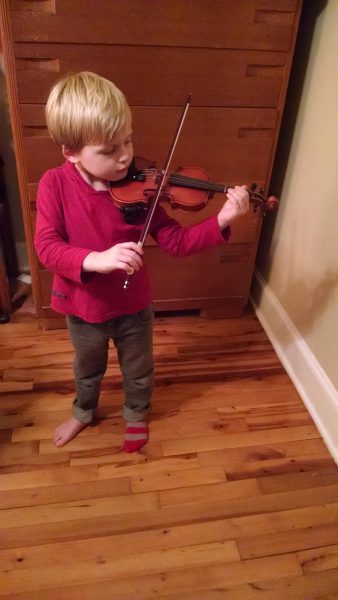
Photo used with permission from Indigo Stephens
“I love having them in class because they always try their best,” Greenwood said. “They try to take what I’m saying and give it a real shot and come back each week having those things learned or accomplished.”
In addition to both playing fiddle on the violin, Indigo plays the bodhran, a type of Irish drum, while Declan plays the dulcimer, a stringed instrument that’s plucked while placed on the lap. Indigo considers the fiddle to be her favorite style to play.
“It’s definitely more lively than the violin,” Indigo said. “One thing I like about it is that there’s such a community around it, and there’s so much culture associated with it.”
This community is one of the greatest advantages of playing traditional Irish music. According to Greenwood, the interest in Irish music has expanded significantly worldwide, with a 200% increase in fiddling students at Riley alone.
“The fiddle is awesome,” Greenwood said. “You get to really show your true personality in your play. It’s a way for you to communicate… and also, no matter where you go, you’re going to find people that you can connect with instantly.”
This connection due to fiddling is not only cultivated with others, but also between the siblings. For many, constant interaction with a sibling could lead to disagreements, however, for the Stephens siblings they have found performing together to be an enjoyable experience.
“It’s really fun to play with Declan,” Indigo said. “We also have a brother and he plays mandolin, and he’s going to come to the school next year.”
Competition amongst siblings is often a sad reality when playing music at a high level, especially when playing the same instrument, such as Indigo and Declan. However, Greenwood feels that playing traditional Irish music avoids this issue as she tries to emphasize personal identity in her class.
“My goal for all of the students is for them to find their own challenge, for them to find their own sound and to figure out what they like, and to try to nurture their individuality as fiddle players,” Greenwood said. “I think it’s great that they are siblings in the class, because then if one of them misses the other one can fill them in at home and they have somebody built in that they can play their tunes with.”
This bond was recently put to the test in February when the siblings performed together at Tune Junkie Weekend in Knoxville, Tenn., an Irish music festival. Indigo and Declan received a scholarship to play the fiddle, receiving free admission.
“We performed some sets with some other people who got the scholarship,” Indigo said. “It was really fun and the crowd clapped a lot.”
Another recent performance for the Stephens siblings was the orchestra concert on March 10, where the orchestra played “An Irish Party in Third Class” from Titantic, with Indigo on the bodhran.
“I heard we were going to be playing that piece as the orchestra, and the teacher said that there was going to be a percussion part, but we don’t have the drum set for it,” Indigo said. “I thought, ‘I know a drum that’s actually Irish.’ So I went up and said [that] I could play my Irish drum with it.
“The bodhran, often referred to as “the heartbeat of Irish music,” is a deeply resonant instrument that evokes a feeling of connection and warmth for listeners. Indigo hopes that her listeners felt similar emotions during her performance.
“Art is all about inspiring emotions,” Indigo said. “I don’t know if there’s a specific emotion [in the piece] but I want them to feel emotions when they hear [it].”
Declan expressed a similar sentiment.
“I hope they want to dance,” Declan said.