


All views shared in the Opinions section of the Chatterbox belong to their respective authors, and may not represent the views of the publication as a whole.
Feb. 14, more commonly known as Valentine’s Day, is characterized by cheap, plastic hearts and an alarming number of aggressively pink aisle displays. A day that lives in infamy to those with empty hearts and wallets alike.
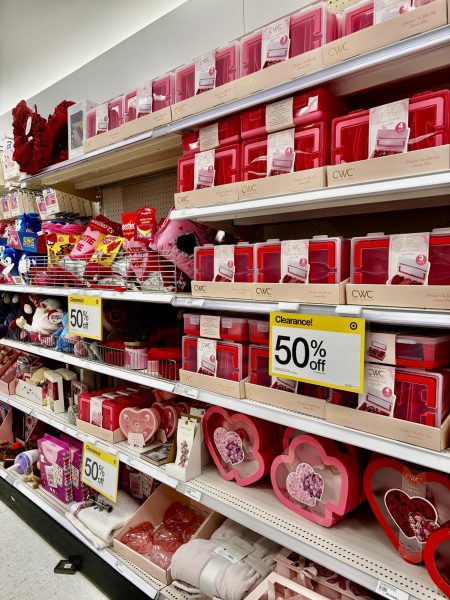
What once began as a celebration of love and prosperity is now a commercial spectacle of “99-cent” chocolates and Hallmark greeting cards we know and loathe.
Beginning in ancient Rome in the late fifth century, the feast of Lupercalia was a holiday observed from Feb. 13 to 15, honoring health and fertility. It is believed that the holiday officially became associated with romance in the 14th century, after being traced back to Saint Valentine.
The shift towards commercialization can be traced back to the late 1800s, when powerful corporations began to promote trends that encouraged gifts as a sign of love, the most notable being the renowned chocolatier Richard Cadbury, who in 1861 launched a campaign introducing heart-shaped chocolate boxes for Valentine’s Day.
Companies and advertisements began to market the holiday, promoting extravagant gifts as a requirement rather than a demonstration of love, disregarding the holiday’s roots in an effort to make more profit.
Tradition can be fun, but meaning disappears when it becomes mandatory.
For teenagers, Valentine’s Day isn’t just a holiday; it’s a social ranking system disguised as romance. Digital culture and school environments amplify this behavior, setting the image that those left without a Valentine are the same unlovable losers they try to convince themselves they are not.
Social media has turned these loving gestures into boastful announcements, pitting relationships against each other in a fierce competition over whose cheap, meaningless gift is best, as those without a Valentine gather as spectators to watch the game unfold.
Pressure builds for teens, forcing them to spend money they don’t have in order to grasp a small sense of superiority from their air-headed classmates, in order to save the last shred of dignity they have left.
Pathetic as it is, this is the unfortunate reality that engulfs high school hallways alike every year, each more puzzling than the last. Besides, nothing says love like calculating how much of your parents’ money you can spend before they notice.
However, this sadistic ritual did not appear out of thin air. Teenagers were not the ones who decided Valentine’s Day would make for the perfect consumer trap; they merely blindly follow a bigger evil.
The real villains at the root of this disgraced holiday are those who sit in boardrooms on the top floor, trying to mark their superiority to all who fall below them. Yes, these were the geniuses who thought, “What if we capitalize teenage insecurity and call it romance?”
Calculated, yes. Surprisingly effective, also yes.
These large companies that monetize on these frail shells of human beings can be blamed for the long tradition of framing love as something that can be bought rather than felt, clamoring once again, trying to prove that money truly can buy happiness.
Over time, the roses will wilt, and love may die, but the credit card bills will last forever.