


At around 8:30 a.m. on Feb. 4, a handful of students stepped out of their cars and walked down the icy path to Entrance C of the Beacon Orthopedics building, prepared for an experience many don’t get to explore until their third year of medical school.
Each year, 16 students in Lisa Brokamp’s CCP anatomy and physiology classes at WHHS get the opportunity to participate in the Beacon Scholastic Bio-Skills Lab to practice medical techniques on real human cadavers. The program was reintroduced this year after a hiatus due to the pandemic.
“I was interested in the Beacon field trip because I want to go into medicine when I am older,” Fiona Manders, ’27, said. “It is really hard to find hands-on experiences for high schoolers, and this opportunity was basically staring me in the face, so I couldn’t pass it up.”
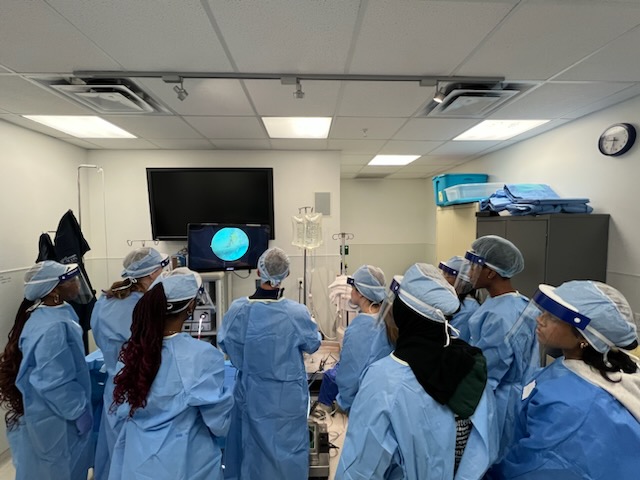
The program was split into three activities. First, students listened to a detailed lecture about the anatomy of the knee, including the names and locations of muscles, tendons and ligaments by Dr. Ian Rice, team physician for WHHS, a new addition to the program. Shortly after, students put on medical gear and prepared to enter the chilly room housing the cadaver knees.

Photo used with permission from Lisa Brokamp
Half of the students began with an interactive session on suturing a wound with a curved needle and thread.
“At first, I wasn’t that good at it; I’m left handed, so I was holding it the wrong way [and] was struggling a lot the first time,” Ella Byrne, ’27, said. “Then I did it the second time and I was holding it the right way, and I could do it, and it was really cool.”
In the meantime, the other group worked on the third activity: using an arthroscopic machine to view and manipulate the inside of a knee, another invaluable interactive aspect of the field trip.
“Not a lot of people can say they’ve used an arthroscopy machine,” Brokamp said. “It opens up kids’ eyes; it builds their interest if they’re thinking about going into medicine or nursing [and] gives them a first hand approach to it.”
Students also had the chance to engage in a Q&A session with Beacon Fellow Ryan Card about having a future in medicine.
“I really liked what [Card] said about how you didn’t have to be the smartest one in the class to do [med school],” Byrne said. “That made me feel more confident, that as long as you study and work hard, it’s something you can do.”
Manders also felt that this experience solidified her plans to enter the medical field.
“[It] helped weed out a sense of questioning I had about whether or not I might get grossed out by seeing body parts, and if I could handle it,” Manders said.
Byrne felt that even though she wasn’t interested in orthopedics, the experience helped her narrow down her interests.

Photo used with permission from Lisa Brokamp
“Even if you realize you don’t like doing surgery, putting on the scrubs and gear is a good experience to have,” Byrne said, “because you can [envision] yourself doing [any type of] medical work in the future.”