



Every day, students walk through cafeteria lines and grab their lunch without realizing that what is on their tray is precisely guided by government nutritional standards, which recently changed.
On Jan. 7th, 2026, the U.S. Department of Agriculture (USDA) and the Department of Health and Human Services (HHS) released their updated Dietary Guidelines for Americans (DGA), a book full of nutritional recommendations that are updated and released every five years to promote public health and shape nutrition standards across the country.
Over the years, the DGA has used a variety of mechanisms to display healthy eating habits to young Americans. The food pyramid, first introduced in 1992, was meant to provide an easy visual guide for healthy eating. It displayed grains on the bottom with oils and fats at the top, translating to “eat more grains and fewer oils and fats.”
In June 2011, the USDA replaced the pyramid with the MyPlate model, first introduced by former first lady Michelle Obama, emphasizing balanced portions on a plate rather than a hierarchy of foods.
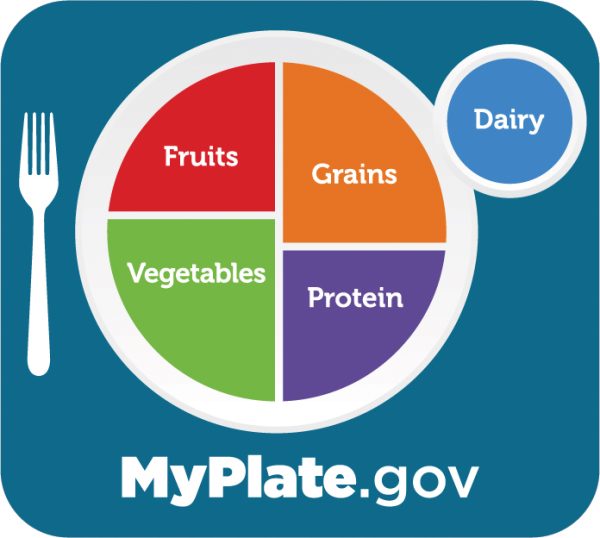
The new guidelines released earlier this year replaced the MyPlate diagram that is widely used across public school cafeterias with an upside-down pyramid. This pyramid flips prior ideas on its head by putting red meats, cheeses and vegetables as the highest priority items and grains as the least.
These changes have sparked debate among nutrition experts and challenge decades of dietary advice. Amy Reed, a registered dietitian at Cincinnati Children’s Hospital, worries the new pyramid may confuse children and families.
“[The food pyramid] was retired in 2011 because at the time those that developed the guidelines concluded that it was confusing and could lead to overconsumption of foods, like simple carbohydrates,” Reed posted on Facebook on Jan. 12. “It was replaced with My Plate which I liked because it provided a great tool to talk with families about how to build a plate. We eat off plates, not pyramids.”
These revised guidelines place less emphasis on limiting saturated fats than previous editions, which has caused controversy among experts. The American Heart Association and the Academy of Nutrition and Dietetics, in particular, are skeptical, as they argue that excess amounts of saturated fats can lead to higher cholesterol and increased risk of heart disease.
At the press conference unveiling these new guidelines to the public, HHS Secretary Robert F. Kennedy Jr. explained the reasoning for these changes.
“The message is simple: eat real food,” Kennedy said. “Together we can shift our food system away from chronic diseases and toward nutrient density, nourishment, resilience and long-term health.”
He pointed to the fact that, according to the U.S. Centers for Disease Control and Prevention (CDC), 90% of healthcare spending currently goes to treating people with chronic diseases, and that this high spending could be prevented through a healthier lifestyle.
The DGA defines the cause of this to be “the predictable result of the Standard American Diet — a diet which, over time, has become reliant on highly processed foods and coupled with a sedentary lifestyle.”
While most people don’t read and follow these dietary guidelines in their homes, they are crucial in shaping what goes into the food for schools, hospitals, military bases and various federal assistance programs.
Cincinnati Public Schools’ (CPS) Manager of Nutrition Lauren Marlow thinks the most visible changes to student meals will be at breakfast.
“You could see some more protein items at breakfast and less sugar-added items like chocolate milk, in order to decrease the overall sugar on the menu,” Marlow said.
However, she does not think CPS will have much trouble adapting to the new dietary guidelines.
“We were already meeting [guidelines] and working towards finding new menu items that were lower in sugar that students would still enjoy, so it’s nothing that we’re concerned about,” Marlow said. “It’s nothing that we can’t do, it’s just educating students and families on [the new guidelines].