


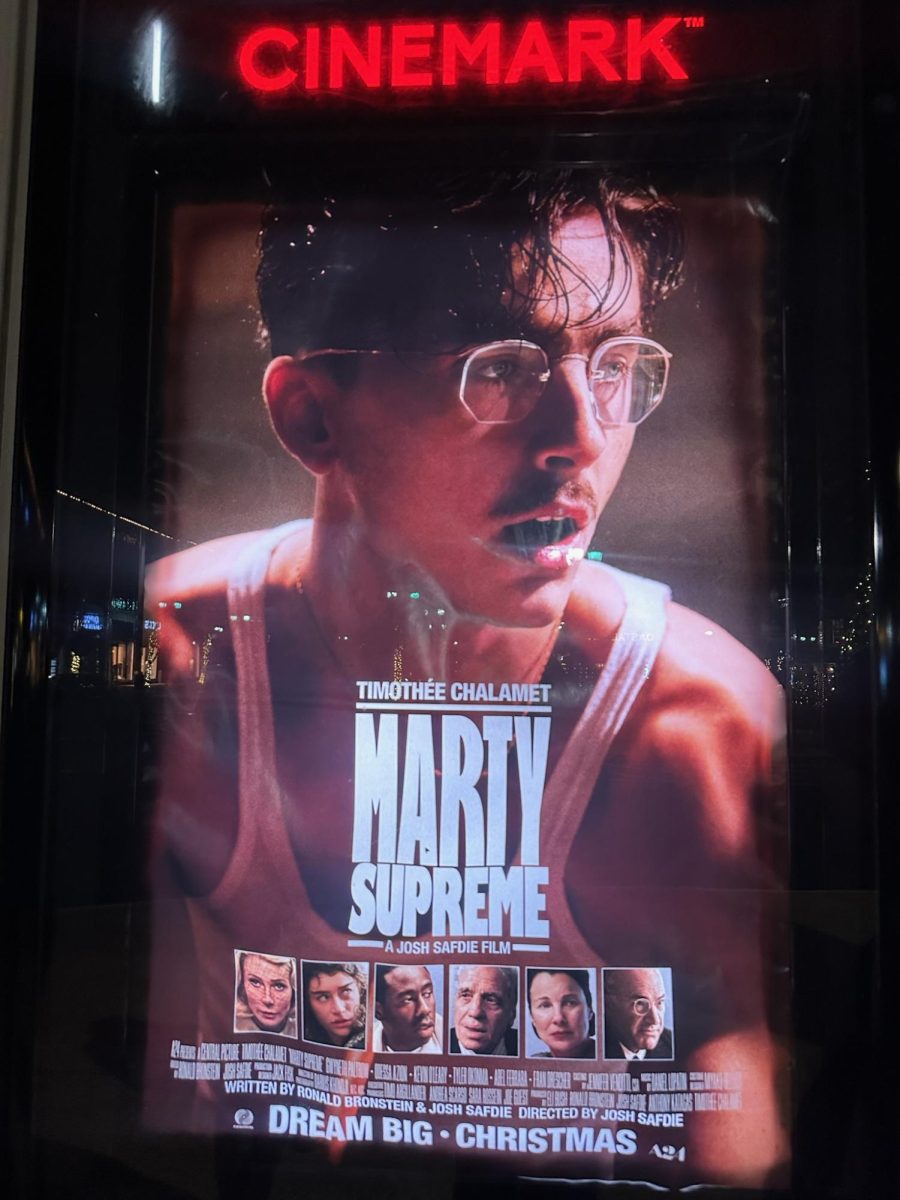
Ever wondered what it’s like to have a panic attack for two hours and twenty-nine minutes? Well, through relentless tension and chaos, Josh Safdie’s “Marty Supreme” beautifully illustrates the anxiety and fragility at the heart of the American dream.
“Marty Supreme” takes place in the 1950s and follows Marty Mauser, played by actor Timothee Chalamet, an ambitious 23-year-old man working at a shoe store in New York City who clings to the belief that he is destined to become a ping pong world champion and will stop at nothing to ensure his success in this venture.
Whilst advancing towards his self-proclaimed destiny, Mauser must navigate complicated relationships with figures from his past, present and future — including his childhood love Rachel, played by actress Odessa A‘zion.
As the film progresses, these relationships erode and become collateral damage by Mauser’s ambition, which personifies Safdie’s testament that, when given the choice, humanity is the scapegoat: the cost for devotion to one’s dreams.
From the opening credit scene, it was clear that “Marty Supreme” was to be no passive viewing experience. It beautifully (and strangely) established the story’s confusing, slightly disturbing mood, characterized by exhilarating cinematic disorientation that puts viewers through a rollercoaster of emotions. This was specifically achieved through the impulsive, ethically ambiguous decision-making of Mauser.
Many words can be used to describe the complex, flawed character that Mauser is; none of them are positive.
Mauser represents everything that is wrong with the United States. His ability to continuously make the incorrect decisions in even the simplest of situations, whilst simultaneously pursuing his all-consuming obsession, confusing destiny with blind ambition, is both marveling and frightening.
These misguided decisions are the leading cause for the nerve-racking nature of the film.
Mauser’s brazen-style boasting of being “burdened with a purpose” leaves viewers completely engrossed, many blissfully unaware of the chaotic microcosm of American culture he is set to represent.
Whether you are entranced or bored out of your mind, Mauser makes it impossible to look away, leaving viewers captivated by the perplexity of his mistakably careful yet careless decisions.
Two exceptional performances supported Chalamet: A’zion’s strong depiction of Mauser’s first and only love, Rachel, and Gwyneth Paltrow’s portrayal of the faded, wealthy 1930s movie star, Kay Stone.
A’zion’s decision to not fade into the helpless girlfriend role, and instead make it her own, was a small yet monumental decision. Though Safdie and co-writer Ronald Bernstein wrote her character to remain loyal to Mauser despite the hardships, A’zion adds her own touch, imbuing the role with such defiance and charm that allow viewers to find connection in even the disorderly of films.
Similarly, Paltrow delivers a mesmerizing performance as a woman who gradually rediscovers herself after decades of insecurity, offering a paradox of delicacy and slowing down amid the film’s fast-paced chaos.
Along with A’zion and Paltrow, Safdie rounded up a vast assortment of talent, each acclaimed in their respective fields, to bring an unprecedented level of authenticity that the film industry hasn’t seen in ages. This paved the way for startling plot developments, and allowed for moments of comedic relief, making even Kevin O’Leary relevant for the first time since… well, ever.
As this article nears a close, I would be remiss not to mention the exceptionally manicured cinematography work of visual genius Darius Khondji. The visual style in “Marty Supreme” draws on a 1970s aesthetic, using vintage Kodak film to enhance the retro vibe.
“Marty Supreme” allowed Chalamet to reach heights I never knew were possible for him, surpassing skeptics’ minimal expectations of him, me included. While I’ve never been one to jump on a bandwagon, after witnessing this transcendent performance, I may have to rethink my previous assumptions.
As I write this, I am sitting here racking my brain trying to find something negative to say about this film, but all my efforts have been fruitless. The dream-team pairing of Safdie and Chalamet crafted a cinematic experience that feels both urgent and lasting.
“Marty Supreme” tells the story of a man who truly believes it when he says, “I have a purpose. You don’t. And if you think that’s some kind of blessing, it’s not.”
This line encapsulates Mauser’s unflinching nerve to jump headfirst into disreputable situations and his complete disregard for others around him in nearly every circumstance, like a true American.