



The government has decided that making pennies is no longer “worth every penny.”
It now costs more money to produce a penny than it is actually worth; according to the U.S. Mint’s 2024 annual report, each penny now costs 3.69 cents to produce.
President Trump first ordered the Treasury Department to stop minting pennies in Feb. 2025, citing high production costs. The move sparked questions about whether he had the authority to make that decision, as only the secretary of the treasury has the power to halt coin production.
On Nov. 12, 2025, Treasury Secretary Scott Bessent followed through on the president’s remarks. The final pennies were produced at the Philadelphia Mint in Pennsylvania, the same place where the penny was first born in 1793.
The penny has a long history. It was one of the first coins produced by the U.S. Mint, which was established in 1792.
The earliest designs of the coin featured a woman meant to depict Lady Liberty, but in 1909, the 16th president of the United States, Abraham Lincoln, replaced her and became the new face of the penny.
Pennies were originally made of 100 percent copper until 1857, when their copper content was gradually reduced due to rising metal costs. The current composition since 1982 has been a 97.5 percent zinc core with 2.5 percent copper as the plating.
Since its early creation, the penny has had a prominent role in American culture.
It is universally thought to bring good luck for 24 hours when found with its head side up.
Even the term “penny candies” has become outdated. Originally named for their low price, it is no longer possible to purchase such products at neighborhood stores.
The U.S. penny outlived the Canadian penny and the one-cent Euro, which were discontinued in 2012 and 2018, respectively. The British penny still survives.
Although penny minting has been discontinued, they will remain in circulation for many years to come. More than 250 billion pennies are lying in coin jars, junk drawers and car cup holders across the country, according to the American Banking Association.
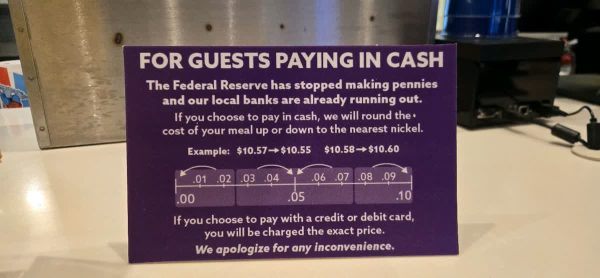
Elon University Economics professor Brandon Sheridan shared his thoughts about the future of cash payments at small businesses with USA Today.
“Some businesses are asking cash-paying customers to voluntarily round up for donations to avoid needing pennies to make change, and to stay compliant with state and local laws,” Sheridan told USA Today. “Other places are rounding down for everyone.”
Rounding payments up or down to the nearest five cents places more demand on nickels. However, coin enthusiasts worry that the nickel could be next, with its current production cost rising to double its actual value.
As the production costs for minting other coins continue to rise and the number of cash-paying customers continues to decrease, the question arises of whether the U.S. will eventually switch to a cashless society.